
Influencer Marketing and Earned Media Work Better Together

By: Julie Stern
July 15, 2026
TL;DR
Stop planning influencer marketing and PR separately. Consumers experience them as one brand story.
Use creators to build social proof and earned media to build credibility and earn third-party validation.
Measure momentum along with other PR metrics.
Marketing leaders face a growing challenge: every channel is competing for budget, yet consumers rarely make purchasing decisions based on a single touchpoint. Consumers don't think in channels. They simply notice when a product consistently appears in places they already trust.
Five years ago, it was common to evaluate influencer marketing, earned media, social media, and retail marketing as separate disciplines. Today's consumers don't shop that way. According to Nielsen's 2025 Annual Marketing Report, consumers engage with an average of 11.1 brand touchpoints before making a purchase.
They might discover a product from a TikTok creator, validate it through an editorial review, compare it on Amazon, ask ChatGPT for recommendations, and finally purchase after seeing it featured in a retailer's email. Yet many brands still manage influencer marketing and public relations in silos.
That's a missed opportunity.
After leading hundreds of integrated campaigns, we've found that the biggest product breakthroughs orchestrate influencer marketing and earned media so that they reinforce one another. When every channel supports the others, brands build more credibility, generate longer-lasting momentum, and maximize the return on every marketing investment.
The Different Roles of Influencer Marketing and Earned Media
The strongest integrated campaigns recognize that creators and journalists reach different audiences, tell stories in different ways, and influence purchasing decisions at different stages of the customer journey. When you understand this, you can design campaigns where each channel amplifies the other instead of competing for budget.
At a high level, influencers demonstrate products in everyday settings while earned media provides independent validation. Together, they reduce skepticism and help consumers feel more confident about purchasing.
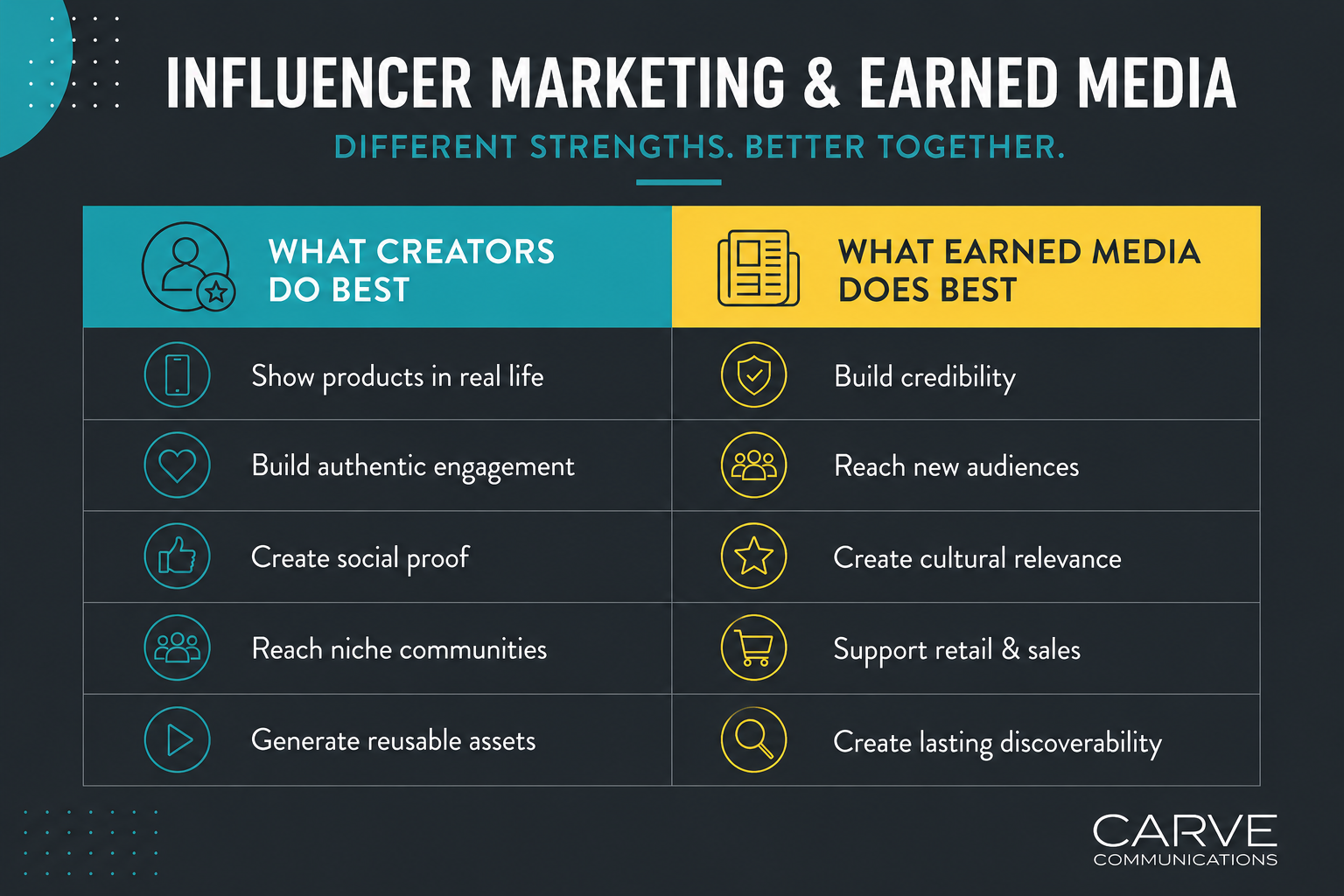
What Creators Do Best
Influencer marketing excels at making products feel real, relevant, and worth talking about. Creators are particularly effective at:
Showing products in real life. Demonstrations, unboxings, tutorials, and day-in-the-life content help consumers imagine how a product fits into their own routines.
Building authentic engagement. Comments, shares, saves, and conversations provide early signals about which messages resonate most.
Creating social proof. Consumers are more likely to trust a product when they see multiple creators independently discussing or recommending it.
Reaching niche communities. Whether you're targeting parents, beauty enthusiasts, gamers, or home cooks, creators often have credibility with audiences that traditional media can't easily replicate.
Generating reusable marketing assets. Influencer content is one of the most valuable assets a PR team can leverage. Authentic product demonstrations, testimonials, and unboxing videos provide proof that consumers are genuinely interested in a product. Instead of telling a television producer or editor that something is generating buzz, you can show them.
According to Sprout Social, 86% of consumers make a purchase inspired by an influencer at least once per year. The best influencer campaigns create valuable content and consumer insights that strengthen every other part of the marketing program.
What Earned Media Does Best
Earned media provides something no paid partnership can: independent validation. Media coverage helps brands:
Build credibility. Editorial coverage signals that your product is newsworthy enough for an independent journalist or producer to cover. That matters to consumers, and to creators. Influencers want to partner with brands that are building momentum, too. Strong earned media helps create that momentum while giving creators fresh, credible reasons to sustain the conversation.
Reach audiences who aren't following creators. Morning television, newspapers, magazines, podcasts, digital publications, and gift guides often reach consumers that social media alone won't. For family brands especially, this matters. Parents, grandparents, teachers, caregivers, and kids all influence purchasing decisions, and they rarely consume the same media.
Create cultural relevance. Media coverage helps position a product as part of a larger trend or conversation rather than simply another product launch.
Support retail and sales conversations. Third-party coverage gives retailers, buyers, distributors, and sales teams independent proof that a product is generating attention.
Create lasting discoverability. Unlike most social posts, editorial coverage often continues appearing in search and LLM results long after publication, helping consumers research products when they're ready to buy.
Overall, earned media gives consumers another trusted signal that your product is worth paying attention to.
Five Considerations for Building Integrated Campaigns
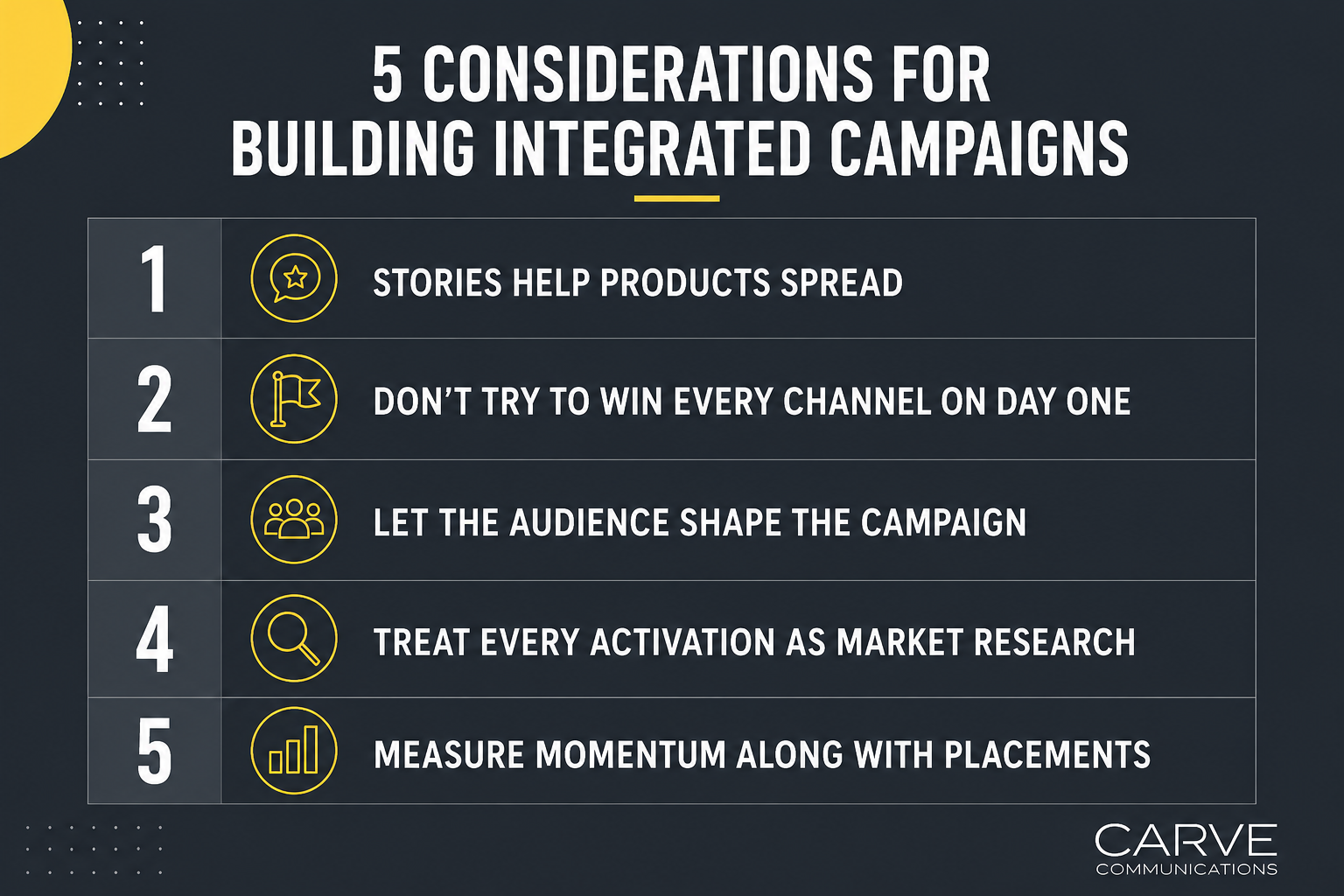
Understanding each channel is only half the equation. The real advantage comes from designing campaigns where every activation creates new opportunities for the next. Here are five principles we use to build integrated campaigns that sustain momentum long after launch.
Stories Help Products Spread – Before recruiting influencers or pitching media, identify the larger conversation your product belongs in. Products launch, but stories spread. Whether it's family game night, reducing screen time, wellness, organization, or sustainability, the broader narrative earns attention.
Look at The LEGO Brand. They rarely lead with “here’s a new product.” Instead, they look for larger cultural conversations that both media and influencers want to participate in. They centered their “Rebuild the World" platform around the importance of imagination, creativity, and play. Every product launch reinforced that narrative.
2. Don’t Try to Win Every Channel on Day One – Any strong story should have legs to be told over a period of time. Plan for where the campaign goes next before it even begins.
For example, let’s say an IRL consumer event is a centerpiece of your strategy. Your first priority may be driving attendance through local media, community partners, and creators. Once the event is over, the focus shifts. The experiences captured that day become new assets for broader media outreach, social content, retailer conversations, and industry thought leadership.
3. Let the Audience Shape the Campaign – Sometimes messages fall flat. Other times you need to amplify what’s getting the most engagement. Educational Insights is a good example of why brands should listen as much as they launch.
Educational Insights realized consumers were buying its games (Kanoodle and BrainBolt) not for children but for elderly parents. Leaning into the all-age concept and mental benefits of puzzles for seniors, Educational Insights and Carve coined the term "Eldertainment." This allowed us to take a toy company beyond the toy aisle with coverage in Forbes to highlight how kids' games can be marketed to an entirely different audience.
4. Treat Every Activation as Market Research – The last activation should leave you smarter than the next one. Which creator messages drove the most engagement? Which products did reporters gravitate toward? Which retailer conversations gained traction? Integrated campaigns create a constant feedback loop, allowing marketers to refine messaging, identify emerging trends, and make every subsequent activation stronger than the last.
5. Measure Momentum Along with Placements. Of course, any PR program should track traditional PR metrics (placements, impressions) along with modern ones like LLM visibility. But integrated campaigns should also create – and track – momentum.
We define momentum as the point when a campaign starts creating opportunities on its own. Here are some of the signals we watch over the first 90 days, and then quarterly as the client or campaign calls for it:
Coverage velocity: What percentage of coverage came after launch week? Did we see follow-up coverage from news outlets?
Search/LLM visibility growth: Have traffic and visibility grown and stayed steadily higher?
Conversation growth: Are consumers starting to carry your story? Are you seeing more UGC, organic social mentions, Reddit discussions, and shares?
Creator inquiries: Are influencers coming to you to ask for product? Are bigger influencers waiving fees because they want to be part of the conversation?
Media inquiries: Are reporters coming to you asking to test product or learn more about the trend? Are they looking to talk to executives?
Taken together, this shows that momentum is building, and your next goal is to keep it going with new angles.
Great campaigns evolve as every placement, partnership, and conversation creates new opportunities to tell the story. How long can you keep the conversation moving?