
The New Era of Press Releases

By: Hailey Pinto and Mariela Azcuy
June 25, 2026
TL/DR:
Press releases have become more important. They still support media coverage, but they also help brands appear in AI-generated search results.
Press releases still don't replace strategic communications. Reporter relationships, compelling stories, and targeted outreach remain what drive meaningful earned coverage.
Not every announcement belongs on the newswire. Distribute strategically based on your business goals, then optimize the release for both journalists and AI systems.
**********
We changed our minds about press releases.
A few years ago, we published a blog arguing that the newswire was not required. At the time, our experience showed that distributing a press release had very little part in securing coverage or building relationships with the media.
The funny thing about experience? It evolves based on the world – and in this case, the technology – around it.
When AI showed up and it started to become clear that press releases had found a new audience with large language models (LLMs), we unpublished the article and dug into the new era of AI press release distribution.
This included everything from tracking how press releases appeared as citations in LLM searches, to implementing AI visibility reporting for clients, to becoming part of an AI beta group with Notified and its GlobeNewswire distribution platform. Then we began to piece this knowledge together to answer the question: “Why are press releases important today?”
Why Press Releases are Important Today
Today, there are a few core reasons why press releases are an important tool – some have changed over time, while others haven’t.
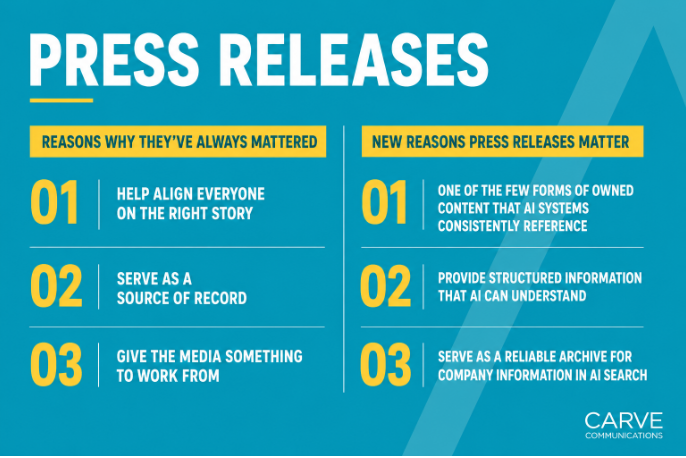
The reasons they’ve always mattered:
Press releases help align everyone on the right story to tell. Internally, stakeholders are forced to agree to the story, the messaging pyramid, and why target audiences would care. Product teams, executives, marketing, legal, investor relations, and communications often have different perspectives on the same announcement. The press release process forces those perspectives into a single narrative. Few communications exercises reveal gaps in messaging faster.
Press releases serve as a source of record. Whether someone is researching a company for the first time or looking back years later, a press release provides an authoritative version of what happened, when it happened, and why it mattered. It creates a single source of truth that can be referenced long after the original announcement.
Press releases give the media something to work from. They are not the pitch itself. The pitch explains why a reporter should care about your news. It’s meant to convince someone to take action. The press release provides supporting details, executive quotes, background information, and facts that reporters can reference, verify, and quote as they evaluate the news.
The new reasons press releases matter:
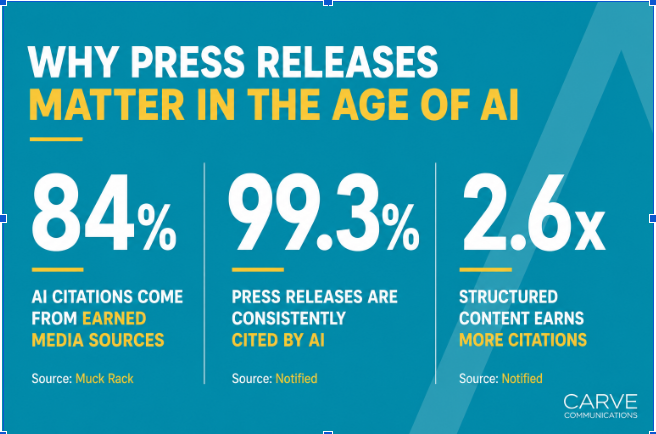
Press releases are one of the few forms of owned content that AI systems consistently reference. Recent research from Muck Rack found that about 84% of AI citations come from earned media sources, including journalism, research, government data, and third-party content.
Yet press releases continue to earn citations and are referenced more frequently in industry trend discussions than any other query type. Separate research from Notified found that 99.3% of analyzed press releases were cited by ChatGPT or Claude, underscoring their role as source material for AI answers. As AI increasingly becomes a starting point for research, press releases serve as a reliable archive for company information.
Press releases provide structured information that AI can understand. Press releases have always been highly structured documents. They contain company names, executive titles, product names, dates, locations, quotes, and supporting facts in a predictable format. That structure makes them easy for journalists to scan and increasingly easy for AI systems to interpret.
The same Notified research found that content optimized for structure generated 2.6x more citations on average, suggesting that well-organized information is more likely to be surfaced and referenced by AI systems.
PRO TIP: Use descriptive subheads and bulleted lists that make a press release easier for both journalists and AI systems to navigate. Some communications teams are even beginning to include FAQ sections at the end of releases to anticipate commonly asked questions and provide additional context.
While AI is giving press releases the refresh they’ve needed, the core purpose remains to create a clear and trusted version of the story. The difference is that today, that story is being read by more than just journalists.
Limitations of a Press Release
Understanding why press releases matter also means understanding what they can't do.
They don't create news where none exists. One of the most common misconceptions about press releases is that they can make an uninteresting announcement interesting. They can't. A press release can package, clarify, and distribute news. It cannot manufacture significance. If the announcement lacks relevance, novelty, impact, or timeliness, the press release won't solve the problem.
They don’t replace third-party validation. A press release is a company talking about itself. While that has value, stakeholders (and AI systems) often place greater weight on independent validation. That's why earned media, analyst commentary, customer stories, and expert perspectives remain so important. A press release can start the conversation, but third-party sources often determine how much credibility it ultimately receives.
They aren’t a substitute for a broader communications strategy. A press release is a tactic, not a strategy. It can support a company milestone, but it doesn't achieve larger positioning, thought leadership, executive visibility, or reputation goals on its own. The best communications programs use press releases as one tool in their toolbox, among many.
They rarely lead to coverage on their own. If your strategic plan is to draft a press release, distribute it across the newswire, and wait for the coverage to follow – prepare to be disappointed. Newswire distribution doesn’t compensate for the targeted outreach required to secure the coverage that drives brand outcomes.
PRO TIP: Always include your contact information on the press release before distribution. While it’s not often reporters will reach out to you after coming across a release on the wire, it does happen. For example, a TODAY Show producer recently reached out to us after taking interest in our client’s press release announcing a “Rock Paper Scissors” celebrity throwdown activation. Not only did the release capture his attention, but it secured a five-minute nationally syndicated TV segment spotlighting the initiative.

When Newswire Distribution is the Right Choice
In general, we’re advising most of our clients to set aside a larger press release distribution budget than they did three years ago.
Of course, there are specific company variables that would influence that recommendation, including the maturity of the company. As a rough example, we’ve told one client who had three press releases to aim for six. Another that had six, we are now striving for eight.
The rise of AI has created a new reason to invest in press release distribution. The key is being selective. Publish when there's something meaningful to say. And if you don't have something meaningful to say often enough, that may be a sign you need to create more news opportunities through research, thought leadership, partnerships, events, product development, or other initiatives.
Consider newswire distribution when:
You’re looking for broader syndication. One-to-one remains the primary driver of original reporting, but it typically only reaches the reporters you contact directly. Newswires create a broader footprint across aggregators, databases, financial sites, industry pages, search engines, and LLMs.
PRO TIP: There are instances where one piece of coverage secured through targeted pitching influences others to write stories – no newswire required. For example, we’ve landed an exclusive in Axios that led to roundup coverage in the Wall Street Journal. We’ve also had provocative LinkedIn posts lead to multiple traditional earned media hits. The point is, there is more than one way to spread awareness, and every opportunity requires a custom strategy based on the desired outcomes.
You want to drive measurable traffic to a specific page. Here’s the spike one client shared with us from their Google Analytics dashboard after their Series B release went out and our coverage hit.
You’re supporting a client that is going public or is about to go public. In these cases, they tend to be required and distribution supports disclosure, consistency, investor communications, and the creation of a clear public record.
You want to tie very specific messaging, offerings, or category language to your brand. For example, one of our clients was launching a government-specific offering that would differentiate itself from the competition. We recommended the wire because we wanted our client to show up when government employees searched LLMs for services like theirs. Of course, we also supplemented with targeted outreach to the government trade outlets.
If none of these objectives matter, draft a release, use one-to-one pitching only, and spend the wire money elsewhere.
PRO TIP: Don't overlook your newswire's backend trade lists. Selecting the right industry categories helps put your announcement in front of the reporters and outlets most likely to cover it. For example, after distributing a gaming-related announcement through targeted entertainment and gaming trade lists, we secured coverage from Game Rant, GamesRadar, ComicBook.com, and BoardGameGeek within a day.
How to Measure Newswire Success
So, how do you know your press release distribution strategy is working? Today, it’s a combination of AI visibility, audience engagement, and the traditional PR performance metrics we all know.
AI Visibility – Is your brand appearing in relevant AI-generated responses? Is the press release itself being cited as a source? Do you have a consistent way to measure exposure across AI platforms over time?
PRO TIP: Don't overlook the AI reporting already available within your newswire platform. GlobeNewswire now tracks "Top 5 AI Citations" for distributed releases, providing a simple way to understand whether AI systems are surfacing announcements. We now include these metrics alongside traditional PR KPIs in client reporting.
Audience Engagement – Did referral traffic increase? Did readers engage as you intended (registrations, downloads, visits, etc.)?
Traditional PR Outcomes – Did the release generate journalist inquiries? Were there meaningful syndication pickups? Did it contribute to earned media coverage in some way?
While we unpublished our original article because the facts changed, the reporter relationships, storytelling, and strategic thinking at the core of PR haven’t. The difference is that press releases are no longer just a document of record. It’s also an asset that can help brands become more visible in the AI era.
A press release will never be a replacement for full-scope PR, but its evolving role is enough of a reason to take it more seriously.